USA: Grand Tetons, Salt Lake City, Snake River

I remember how happy I was when I finally visited Mt. Rushmore. Mt. Rushmore had been on my “wish list” for many years and I was delighted when my youngest daughter, Erin, suggested a cross-country trip. In all my years of traveling I had never been to the Grand Tetons, visited Yellowstone National Park, or traveled to South Dakota to experience Mt. Rushmore.

It was a wonderful trip and driving is a great way to see the US. As I tell my clients, planning a trip is half the fun … and Erin and I had fun. At the time Erin was a second year medical student at Albert Einstein College of Medicine in New York. We had a limited time frame (two weeks) and I knew we could not drive the entire way across the US, and see everything we wanted to see. So early in the planning I decided we would rent a car in Redlands and drop it off in Chicago. From Chicago to New York we would take the train and I would fly home from New York.

With that plan in mind, we took out our maps and decided where we wanted to go, and what we wanted to see. With the computer, mapping our route was easy. And the GPS proved invaluable. It’s like a cell phone --- I now wonder how I ever got along without a GPS in the car.

As much as I travel, this trip was definitely a learning experience. My first “learning experience” was renting a car. I’ve rented lots of cars throughout the years, but usually just for city driving and sightseeing, not a long road trip. I made reservations with Hertz and picked up the car in Redlands. I requested a mid-size car, and that’s what I got --- a KIA. I didn’t bother asking if it had four, six or eight cylinders --- to me a car is a car. Not anymore. A four-cylinder car may be fine for city driving, but leaves much to be desired for mountain driving. The car was a gutless wonder. The moral of the story is to tell the car rental company where you are going (which I did), and insist on a more powerful car (which I didn’t. )

We actually got away early in the morning and headed northwest to Las Vegas. I enjoy driving and even though most people think the drive to Las Vegas is boring, I love the moonscape -like scenery of the desert. What was strange was passing Las Vegas; our first stop was Salt Lake City. In all the years of going to Las Vegas, I have never driven north of Las Vegas. The red cliffs of northwest Arizona into Utah are absolutely beautiful.

We found a hotel in downtown Salt Lake City and walked to the city center for dinner. After dinner, we headed for Temple Square, the most popular tourist attraction in Salt Lake City, with the beautiful Mormon Temple and the home of the Mormon Tabernacle Choir. Neither Erin nor I had been to Salt Lake City. When you first see Temple Square, an entire city block ablaze with light, it’s an awesome sight.

Unfortunately, I did not read my literature before leaving Redlands, or I would have known that there are hosted tours of the complex (not the Temple) which is open 9:00am to 9:00pm daily. I will call this learning experience #2 --- read your literature before going on your trip. Seriously, if you are planning a trip to Salk Lake City, I suggest going online and finding the pertinent information, i.e. location, hours of operation, times of tours, etc. Also, adjacent to Temple Square is the Museum of Church History and Art, the Family History Library and the Joseph Smith Memorial Building.

We were up bright and early the next morning and on the road by 6:30am --- our destination was the Togwotee Mountain Lodge in Moran, Wyoming, about 40 miles north of Jackson Hole. As we headed out of Jackson Hole we had our first panorama of the Teton Range---magnificent is the only word that comes close to describing the breathtaking view.


We stopped at one of the pullouts along the road and stood in silence as we took in the surrounding scenery. It actually looks like a painting. I have seen mountain ranges throughout the world: the Alps in Switzerland, the Andes in Peru and the Himalayas in India ---the Grand Tetons are just as spectacular, and a lot closer!!!

We arrived at the lodge in the early afternoon and immediately put on our hiking boots. We were on the lookout for wildlife as we followed a trail down to the Buffalo Fork River. We didn’t run into any moose or bears (thank goodness), but enjoyed our hike and the glorious wildflowers along the trail. We finished the day with a soak in the lodge’s hot tub.

The nest morning we drove into the Grand Teton National Park, founded in 1929. The park encompasses over 300,000 acres and offers an abundant of activities for the entire family. There are several visitor centers throughout the park that provide information on hiking, camping, backpacking and climbing (overnight trips require a permit), horseback riding, bicycling, fishing, wildlife viewing and river rafting. The visitor centers also have wonderful information available on the culture and history of the area going back thousands of years to the early peoples (Paleo-indians) and native Americans that inhabited the land. A fun and educational experience for the whole family.

After some discussion, Erin and I decided on a rafting trip down the Snake River.

Once again we were treated to spectacular views of the entire Teton Range. We also saw an effusion of wildlife including some bald eagles, moose, some osprey (who performed their fabulous fishing techniques for us --- a dive straight down) and some Canada geese. The area is beautiful and provides a quiet peace with the abundance of wildflowers and the surrounding forests of spruce and cottonwoods.

By late afternoon we were again on our way --- Yellowstone National Park. Join me next as Erin and I explore the park’s hydrothermal features and check out the area wildlife.


USA: Yellowstone

Even though most of my group trips are abroad, some of my favorite destinations have been much closer to home. As a child we didn’t do a lot of traveling. When I had my own family we did travel considerably, but never made it as far north to Yellowstone National Park. So Yellowstone was definitely on my itinerary as Erin and I continued our cross-country adventure.

Erin and I were excited as we drove through the South entrance of Yellowstone National Park. We picked up a map and other literature from the Park Ranger and headed for Grant Village. Throughout the park there are several “villages” which provide lodging, food service, camping sights, stores, service stations, visitor information, etc. When I called for reservations in early April (for the following August), they did not have availability at Old Faithful Inn, my first choice for accommodations because of its notoriety and reputation. If it’s important for you to stay at the Inn, I suggest you call a good year in advance if you are planning on visiting Yellowstone in July or August. Since the Inn was not available, I chose Grant Village because it was closest to the South entrance, and easily accessible to the East entrance, the entrance we planned to leave from as we headed east toward South Dakota.


Established in 1872 by the United States Congress, Yellowstone is the first, an oldest, national park in the world. The park was originally established to protect the unique geysers, hot springs and other hydrothermal features that comprise more than 2.2 million acres. Before going to the park, my knowledge of Yellowstone was limited to Old Faithful, the best known of the geysers. However, I soon learned, there is definitely more to see than Old Faithful.

We checked into Grant Village and immediately headed to the West Thumb Geyser Basin to begin our exploration. In the summer months there are Ranger-led programs throughout the part, with times listed in each village and in the National Park Information Guide. There are also wonderful maps for self-guided tours, and pamphlets available (for a small fee) at all the major thermal attractions.


The West Thumb Geyer Basin overlooks Yellowstone Lake, the largest lake at high elevation (7,723 ft.) in the Western Hemisphere. Without getting overly scientific, the bay of West Thumb is actually a volcanic crater or caldera, created thousands of years ago after a powerful volcanic explosion. The West Thumb caldera lies within an even greater caldera, which actually encompasses the central and southern portions of the park. Within the central basin are several geysers and hot springs. Due to a variety of geologic conditions, geysers may have short periods of dynamic eruption followed by long periods of dormancy. The highlight of the basin was the Thumb Paint Pots, several miniature mud volcanoes (3-4 ft. height) with steam curling from small chimney-like cones. Surrounding the cones are boiling “mudpots” --- I felt we were in the midst of a science fiction movie and I expected to see a monster explode out of the depths of the boiling mud. No such monster appeared --- only ribbons of steam. The walk around the basin took about two hours.

We drove back to Grant Village and had dinner at the lake-side dining room. Full service restaurants are at a premium in the park and reservations are a must. In fact, I suggest making dinner reservations the same time you make hotel reservations, particularly if you want to eat at Old Faithful Inn. Check on-line for the different type of in-park accommodations and dining facilities.Since we only had two days in the park, we were up bright and early and on the road by 6:00a.m. We planned to do a loop --- seeing the major gyser areas along the road, passing through Hayden Valley, through Canyon Village and the Grand Canyon of Yellowstone (with its spectacular waterfalls), through Norris Geyser Basin, the Lower Basin and unto Old Faithful. As we left Grant Village we had our first wildlife sighting, a beautiful elk crossing the highway. Erin and I were so excited. As we passed Yellowstone Lake and approached Hayden Valley, we saw our first bison --- Erin let out a scream, which you would surely understand if you saw a 2,000 pound bison sauntering down the road toward you. It really is an amazing sight. We soon found the rest of the heard and pulled to the side of the road to watch the dozens of bison that began to appear on the hills and grassy areas along the main road.

There are three signs you see everywhere in the park. One is to caution people about the danger of scalding water and the need to stay on designated paths and boardwalks. Yellowstone’s hydrothermal features are frequently near or above boiling, and the crust surrounding them is thin and breaks easily. The second sign cautions people to stay away from wildlife. Yellowstone is not a zoo, and the animals are not tame, they run freely in the park. Besides bison and elk, there are coyotes, moose, bears, deer, bighorn sheep and wolves. The third and most prevalent sign, is the 45-mile speed limit posted frequently along the road. In the summer months that usually is not a problem since the roads in Yellowstone are packed with cars. The real danger is when people suddenly stop because they see wildlife. Usually a traffic jam ensues, particularly if the wildlife moves onto the road and cars are afraid to get too close, as is the case when a herd of bison crosses the road.


After our initial bison sighting we almost became immune to seeing these magnificent creatures and continued on our way. After stopping in Canyon Village for a much-needed cup of coffee (no Starbucks, but Seattle’s Best was equally as good), we continued on to the Grand Canyon of Yellowstone; the canyon plunges 1,000 feet down with dramatic waterfalls and colorful rock formations. Puffs of steam mark hydrothermal features in the canyon walls. You can experience the canyon from a variety of overlooks or, time permitting, you can follow a number of trails and walkways that wind along the rim and down into the canyon. It really is a spectacular view.

As we continued our loop, we stopped at Mud Volcano with its explosive mudpots, Sulpher Caldron, Norris Geyser Basin, the hottest and most dramatic geyser basin in the park, Fountain Paint Pot with wonderful examples of the four types of hydrothermal features (geysers, hot springs, fumaroles and mudpots), and onto the Upper Geyer Basin, with the world’s largest concentration of geysers and hot springs, including Old Faithful.


We first visited the Old Faithful Visitors Center and checked out the geyser’s eruption predictions. The eruption length and height, and the time between eruptions, vary from day to day and year to year. When we were there in August, the average interval between eruptions was 94 minutes. Old Faithful is a cone geyser, which erupts in a narrow jet of water, and just prior to eruption, the water temperature at the vent is 204 degrees Fahrenheit. Hot.


L

After viewing the eruption we picked up an Old Faithful Area Trail Guide and continued around the Upper Geyser Basin. There are several trails ranging from .7 miles to 4 miles in length --- we chose the Geyser Hill Loop (1.3 miles) that took us past a number of geysers and hot springs.

As a travel agent I couldn’t visit Yellowstone without seeing the Old Faithful Inn, one of the largest log cabins in the world. As I walked in the front entrance, I was immediately taken aback by the immense size of the lobby with it’s 85 foot tall ceiling, huge stone fireplace, and overhanging balconies and railings, all made from twisted, gnarled logs. The lobby was packed with tourists --- it was fun just sitting in one of the many rocking chairs scattered throughout the lobby listening to all the hubbub, in a dozen different languages.


We tried again to get dinner reservations at the Inn, but nothing was available until after 9:30. We ended up walking across the parking lot to the Snow Lodge and had a lovely dinner in the main dining room. The Old Faithful Snow Lodge, an impressive building on its own, was built in 1999 and adds additional room capacity to the area around Old Faithful.

We arrived back at Grant Village, exhausted and ready for a good nights sleep. Erin had kept me on the move all day and my muscles were definitely feeling the miles of trails we hiked.

Join me next week as we visit Mr. Rushmore and the beautiful Black Hills of South Dakota.

USA: The Badlands of South Dakota

When Erin and I started planning our driving trip across the northern US, we each picked out several things we wanted to do and places we wanted to see. Yellowstone National Park, Grand Teton National Park and Mt. Rushmore headed the list. We then had to make choices. I was surprised at how many national parks and national monuments there are in South Dakota. We wanted to spend more time in the Black Hills with its rugged rock formations, canyons and gulches; visit Wind Cave National Park with over 100 miles of underground passageways; see the historic town of Deadwood, an old mining town in the Black Hills long associated with gambling and shady characters, and the final resting place of Wild Bill Hitchcock and Calamity Jane. Unfortunately, we had to be in Chicago by a certain date and realized we could not possibly see it all. We finally decided on Badlands National Park, best known for its dramatic vistas and fossil resources, and where the famous dinosaur, Sue, was discovered 15 years earlier (Sue is now on display at the Field Museum in Chicago).

We left Keystone early and headed east on I-90. Once past Rapid City, we began seeing signs for the town of Wall. Sign after sign after sign --- it went on for miles and miles --- advertising Wall Drugs. Even though we were on a tight schedule and Wall was definitely not on our itinerary, our curiosity got the best of us and we ended up stopping in Wall. Wall Drugs is a huge, old-time store that goes on forever and ever---it actually covers an entire city block. With its early west atmosphere, it reminded me of the type of stores you find at Knott’s Berry Farm. Unless you have lots of time I really don’t recommend stopping at Wall. However, I do commend the marketing person who thought up all those signs --- it worked. I can now say I’ve to Wall, South Dakota!

From Wall we took Highway 240 into Badlands National Park. The park encompasses over 240,000 acres of sculptured Badlands and mixed-grass prairie. With limited time, we selected the Badlands Loop Road, a 30-mile drive that would take us past several scenic outlooks, nature trails and the Ben Reifel Visitors Center. We entered the park through the Pinnacles Entrance and our first stop was the Pinnacles Overlook. Before us lay a vast expense of deep gorges and knife sharp ridges with rock layers “painted” in hues of red, gold and green.

Mother Nature has been at work. It’s hard to condense what took place over 75 million years, but it was a combination of shifting weather patterns and geological forces that transformed the area into what we now call the Badlands. According to park literature…”Forests flourished and withered away. Volcanoes laid down a thick layer of ash and rivers repeatedly flooded the region, depositing sediment. The black, muddy floor of the Pierre Sea apparently compressed into a band of 2,000-foot-thick shale. These successive layers of matter often held the bodies and bones of animals now long extinct and preserved for posterity as fossils.” Erosion did the rest. Wind and the rushing waters of rivers, now long vanished, eroded the dry, fragile soil, gouging out channels and gullies, and carving the cliffs, spires and odd rock formations you see throughout the park.

As we drove along the Loop road you can actually see the “layers of time.” Different amounts of red-brown iron oxide mixed in the sediments give varied hues to each layer. And each layer contains different fossils from the different geological periods. Over the years, paleontologists have found the fossilized remains of saber-toothed cats, miniature camels and horses, huge rhinoceros-like beasts and small squirrel-like rodents. Today, the Badlands area has the distinction of being known as having the world’s richest Eocene/Oligocene Epoch fossil beds.

We continued driving along the Loop Road, stopping several times at scenic overlooks to marvel at the magnificent vistas. We pulled out our binoculars in hopes of seeing some Bison or Bighorn Sheep, but never did manage to find any. There are also several self-guided trails, which are easily assessable from the Loop Road. The Fossil Exhibit Trail features fossil replicas and exhibits on now extinct creatures that once roamed the area. The trail is a quarter-mile and takes about 20 minutes. It is also wheelchair accessible. Other trails along the Loop include the Medicine Root Trail, the Cliff Shelf Nature Trail, the Castle Trail and the Notch Trail --- all very in length and accessibility. Some are definitely more strenuous than others.

Half way through the Loop is the Ben Reifel Visitor Center. Besides the much welcomed “facilities,” the center offers an orientation program in the auditorium and has a small museum featuring natural and cultural history exhibits. The orientation program, a combination of a short film and a talk by a Park Ranger, is excellent and provided good background information on the area now known as “the Badlands.”

Unfortunately, time was our biggest problem. In hindsight, I definitely would have planned an entire day to explore the area. Badlands National Park is opened year-round; however, not all of the facilities are open in the winter months. Accommodations in the park are limited. The Cedar Pass Lodge has small cabins with air-conditioning and private bath. It also has a full service restaurant serving breakfast, lunch and dinner. There are also several campgrounds operated by the National Park Service. If you’re into hiking, camping, backpacking, bicycling, wildlife viewing or horseback riding, and have an interest in geology and paleontology, Badlands National Park is a perfect vacation destination for the entire family.

Join us next week as we explore the “windy city” --- Chicago.

USA: New York City

This article is a continuation of my trip across the United States with my daughter Erin. Our trip started in Los Angels and ended in Manhattan, with stops at Yellowstone National Park, Mt. Rushmore, Badlands National Park and Chicago.

I’m a train buff from way back. When Erin and I first talked about our cross-country tip, I thought it would be fun to take the train from Chicago to New York. Erin was less enthusiastic, particularly since we were not planning to get a sleeper compartment for the 19-hour trip.

I won’t go into detail, but I will admit I should have listened to Erin. The seats on Amtrak are not made for long-distance sleeping, plus, being summer vacation, there were lots of young children in our car. The 19-hour trip turned into 22 hours and I was very happy when we finally pulled into Penn Station in New York.


Erin was delighted to be back in the Big Apple. She perked right up and, like a native New Yorker, grabbed for our luggage and queued up for a cab to take us to the Bronx. There is a certain excitement about being in downtown Manhattan with the hustle and bustle of cars and people, like turning a video on fast forward and watching life go by in the fast lane.

We finally arrived at her apartment and I was immediately thankful we hadn’t been there a week earlier, during a blackout. Erin’s apartment was on the 27th floor!!!

Since I have been to New York several times I could be a more selective tourist. Within the past year I has taken the Circle Line tour around New York Harbor, visited Ellis Island, rode the elevator to the top of the Empire State Building and experienced the sadness surrounding Ground Zero. I walked from the East Village to 42nd Street and window shopped all along 5th Avenue.

This trip we decided to focus on museums. At that time Erin was a student at Albert Einstein College of Medicine in the Bronx. Just off campus is the express bus to Manhattan---within 45 minutes we were in the city and walking into the Guggenheim Museum.

The building itself is a work of art. Designed by Frank Lloyd Wright, it is a masterpiece of modern architecture. The art inside includes a world-renowned permanent collection of works by Chagall, Kandinsky, Picasso and van Gogh, plus changing exhibits from other modern masters. Compared to most museums, the Guggenheim is small and the layout makes it easy to see the art on display; you wind your way up on one side and down on the other.

By 3:00pm we were museumed out and we decided it was time to head for Times Square. We wanted to see a Broadway show and Erin was going to introduce me to the kiosk in Times Square that sells half-price theater tickets. For the past several years I have ordered tickets online, but Erin convinced me it wasn’t necessary, as long as I didn’t want to see the newest show on Broadway. Even though it was a Friday night, Erin assured me we would get good seats to a play. Plus standing in the middle of Times Square, just watching people, is a show in itself. Where else can you see the “Urban Cowboy” in a pair of jockey shorts, wearing yellow boots and a cowboy hat, strumming his guitar?

Erin was right. By the time we reached the box office we had several shows to choose from. For sentimental reasons I decided on “Gypsy” starring Bernadette Peters. Without aging myself too much, I had seen the original production on Broadway, starring Ethel Merman, back in the 60’s. Erin had never heard of Gypsy Rose Lee, or Ethel Merman, but thoroughly enjoyed the show. We sat in the front row mezzanine and the tickets cost $50.00 each (you do have to pay with cash, no credit cards are accepted).

Before the show we had an early supper at Ruby Foo’s, a Pan Asian restaurant off Times Square. A New Yorker friend recommended the restaurant because of its exotic drinks. I’ll recommend the restaurant because of its menu, a combination of sushi and Chinese. We had a great dinner. After the show, about 11:30, we walked back through Times Square. It could have been 6:00pm and the middle of rush hour. I couldn’t believe the number of people out in the middle of Times Square. We did some shopping at the many stores still open and then walked to Madison Avenue to catch the bus back to the Bronx; a fun-filled day in New York City.

The next afternoon we were back in the city to visit the Metropolitan Museum of Art. This is one of the world’s great art museums, definitely in the same league as the Louvre in Paris and the Rijksmuseum in Amsterdam. Their permanent exhibits span the centuries and the globe with treasures from medieval Europe to ancient Egyptian sculptures. No matter how wonderful the exhibits, I decided you could only spend so long in a museum. For a change of pace, and a breath of fresh air, we took the elevator to the roof to see the Iris and B. Gerald Cantor Roof Garden, which offers a spectacular view of Central Park and the New York skyline; a far different view then we usually see with the sharp contrast of green against the tall high-rises of glass, brick and concrete.

I left New York on Sunday evening. Our two-week trip across the United States had been wonderful. The Grand Tetons are magnificent, Yellowstone National Park a true scientific wonder, Mt. Rushmore is breathtaking, a must for all to see, the Badlands are awesome, and Chicago, a beautiful and fun city with wonderful architecture. Our biggest problem was time --- there is just too much to see in only two weeks.

I hope you enjoyed reading about our trip and learned from my mistakes. I also hope this inspires you to experience America --- in all it’s natural beauty.

TIP: Have a professional on your team!

It’s nice to have a travel professional on your team.

I often get calls at the office from people who are planning a trip using the Internet, and want information about hotels, airline flights, car rentals, etc. I even get calls from people who have already made their reservations on the Internet and now want to change them, and ask for our help.


Over the years I’ve written numerous columns explaining the importance of using a travel professional when booking travel. What took place last week, with the demise of three airlines, the difference between going “online” and working with a travel professional became even more apparent. When I heard the news that Aloha Airlines had filed for Chapter 11, I immediately looked up all our clients that were holding tickets on Aloha Airlines, called them, and attempted to rebook them on any available flights. The same thing happened a few days later when American Trans Air declared bankruptcy. I heard the announcement at 5:00AM when I turned on the morning news and was in the office by 6:00 to see if any of our clients were caught in this unfortunate turn of events. And I wasn’t alone.


On Saturday, April 4th, I was at a travel conference in Los Angeles and heard the same story time after time, travel agents scrambling to find flights for their clients who were ticketed on either Aloha or American Trans Air. I wonder if Travelosity or Orbits were also on the phone, notifying people who used their sites and purchased tickets through the Internet?


I’ve come to the conclusion that some people are under the impression that they get far better rates on tours, hotels, cars, cruises, airfares, etc. over the Internet. Most of the time that is not the case. Plus many people purchase their vacation package and really don’t know exactly what they have purchased. Also, when you book a cruise directly with the cruise company, a Hawaiian vacation directly with Pleasant Hawaiian Holidays, a biking or hiking trip with Backroads, a rafting trip through Row Adventures or a European trip directly with Globus Vacations, for example, the price is not any lower than if you booked it with a travel agent. What you do get for the same price is the same reservations through a travel agent, with the bonus that you have a professional on your team, someone who takes care of any problems that might arise and makes sure you get what you pay for.


First, let me clear up some confusion about how travel agents get paid. The cruise companies, the tour companies (wholesalers that put together packages to Hawaii, Mexico, Europe, etc.), hotels and car companies pay commissions to the travel agent. Because the airlines no longer pay commissions to travel agents, most travel agencies have attached a fee for airline reservations and ticketing, from $25.00 to $35.00 per ticket. Some agencies have also created a “plan to go” fee, usually $100.00 for their expertise in putting together a custom trip. That fee is usually applied toward the reservation and deducted from the final payment. If you decide not to go, the fee is non-refundable and pays for the travel agent’s time and knowledge.


For example: if you go to an accountant to have your income taxes done and he spends an hour or so talking to you, and then you decide you’ll do it yourself on Turbo Tax, should you have to pay for the original appointment? If you go to a lawyer to draw up a will and then decide you can do it yourself online, should you have to pay for the time you originally spent with the lawyer? Absolutely. Why is it different with a travel agent? Professionals should be paid for their expertise.


I’ve traveled extensively and have a lot of experience from which I’m able to draw. I use reliable companies for my clients. I have my favorite hotels (from experience) in Paris, Rome, London and many other locations. I’ll tell you if there is construction going on at the Four Seasons in Lanai and suggest an alternative hotel or destination. Is August a good time to take a Caribbean Cruise? I’ll talk to you about insurance, is it always necessary? Should you drive from Rome to Florence or is it better to take the train? Do you need to reserve seats on European trains? The list goes on and on.


If you don’t travel extensively, there are many terms used by the airlines, cruise companies, tour operators and insurance companies that are confusing.

What is the difference between a direct flight and a non-stop flight? A non-stop flight goes from point A to point B, without a stop, i.e. LAX to Miami. Some flights, though they appear to be non-stop when you look on the computer, can actually stop one or two times prior to your final destination, but you do not change planes, i.e. LAX to Miami with a stopover in Dallas. That is considered a direct flight.


What is the difference between ‘bulk” air and published air? These terms are usually associated with tour operators that have contracts directly with the airlines. Many large tour companies, because of the large number of people they send to specific destination, have contracted with the airline for a lower price on certain routes. Examples of this are LAX to Maui or Honolulu. A tour company may be able to get you a ticket to Maui, as part of your vacation package, for $400.00 roundtrip. When you try to book it on the computer, that same flight may cost you $500.00.


On the subject of travel insurance--when you purchase travel insurance be sure to ask your travel agent what it covers. Most of the time it is for medical reasons or illness or death in the immediate family. It will not cover you if you decide to get a divorce, are called to jury duty, or are refused a visa (into a country) after you bought your trip and purchased airline tickets. It’s also important when you purchase your insurance. If you purchase your insurance within a certain time limit of paying your deposit (usually a week to 10 days) the insurance will cover pre-existing medical conditions. If you have been under a doctor’s care for a heart condition and you end up canceling your trip due to a heart attack six months down the road, your insurance would pickup any cancellation fees incurred. Many insurance premiums also cover lost baggage, trip cancellation insurance, trip delay, medical evacuation, doctor’s visits, etc. Also, most travel insurance sold by independent companies is based on the cost of the trip and your age. Talk to your travel professional to see what type policy would be best for you.


If you’re planning a trip in the near future, remember, call your favorite travel agent and have a professional on your team.

ISRAEL 08 #1: Returning to Israel

When I originally planned my trip to France in early January 2007, I had planned to return home October 22nd with my group. I had a trip to Cuba planned for early November and I wanted some time to rest and get out my warm weather clothes. However, in August I received a call from my daughter Heather living in Israel. Heather had met a young man, Rob Tzall, an American also studying in Jerusalem, and they wanted to get married the end of October, if I could be in Israel.

Somewhat surprised and excited, I explained my travel schedule and said I could certainly be in Israel between October 22nd and November 6th. The wedding date was finally set for November 4th and Carolyn Groves and I flew out of Paris to begin a 16-day trip in Israel.

I had not been to Israel in over 40 years. When I graduated high school I traveled to Israel with a youth group and worked on a kibbutz for a summer before starting college. I was excited to go back and was looking forward to meeting my future son-in-law. Because I had not been to Israel in so many years, and the country has changed dramatically, I set up a 10-day tour by private car. My cousins, Irwin and Josephine Furman, joined Carolyn and me for the tour, and of course, stayed for the wedding.

Heather and Rob met us at Ben Gurion Airport in Tel Aviv and we had a joyous reunion. I was delighted to meet Rob and hear all about the wedding plans. We had a wonderful dinner and were sad when they headed back to Jerusalem; Rob is finishing his studies at the Yashiva (school) and Heather is working as a special events coordinator with AISH, an American company with offices in Jerusalem.

We spent the night in Tel Aviv and early the next morning met our guide and driver, Brenda, to begin our tour of the Holy Land. The term Holy Land is usually referred to as a Christian tour. Since half of our small group was not Jewish, I combined an Israel tour and a Holy Land tour. Our guide was well versed in both the Old Testament and the New Testament, which provided a wonderful and meaningful experience for us all.

We left Tel Aviv in the morning and drove to Jaffa, an ancient port near Tel Aviv where Jonah set sail and where Peter had his housetop experience at the home of Simon the Tanner. As we walked along the cobblestone streets, now filled with charming boutiques and galleries, it was hard to visualize what it looked like 2000 years ago.

We drove along the beautiful Mediterranean coast to ancient Caesarea, a walled city built by King Herod over a twelve year period between 23-13 BC. King Herod wanted to build a monument to show his gratitude to his Roman patron, Caesar Augustus. In the year 10 BC, he launched one of the largest building campaigns ever conducted, turning Caesarea - named after the Roman emperor - into one of the most striking cities of its time in the world. When the Romans assumed direct control over Judaea in 6 CE, Caesarea became not only the capital of the province (a role it played for the next 500 years), but the headquarters for the Roman legions stationed in Judaea. Caesarea is an important site in both Jewish and Christian history.

We toured the Crusader fortress, the aqueduct (originally built by Herod in the first century BCE, which conveyed water to the city from springs at the foot of Mt. Carmel, over 7 miles away), and the ancient amphitheater where concerts are still being held on a regular basis.

The highlight of the day was our visit to a Druze Village, high in the Carmel Mountains. I was not at all familiar with the Druze religion and was surprised to learn that over 100,000 Druze live in Israel, have Israeli citizenship and even serve in the Israeli Defense Forces (the Israeli army). According to our guide, the Druze religion was founded in the eleventh century by al-Hakim, 6th Fatimid Caliph, as a reform movement within Islam. The Druzes are strict monotheists. They revere Hakim as an incarnation of God, and expect him to return one day. Druze are also unitarian, believing all mankind to be divine. They believe in reincarnation and the spiritual superiority of women. One must be born into Druze in order to be initiated. One cannot convert into the religion.

It was a wonderful afternoon. We had lunch at a private home in the village. The food, mostly salads, humus and freshly made pita bread was fabulous. A member of the family joined us for the meal and we were able to ask questions about their lifestyle and religious beliefs. Basically, Druze accept the Koran, the Judeo-Christian bible, and the writings of Hakim as meaningful.

After lunch we continued through the mountains to Muhraka where, according to the bible, Elijah defeated the prophets of Baal. On top of the mount is a dramatic statue of Elijah, sword raised to heaven, and a lovely Carmelite monastery. From the top of the monastery, on a clear day, you can see the entire Carmel Valley and the mountains near Nazareth. The name 'Muhraka,' or 'place of burning,' refers to a time when this extraordinary vista point was a sacred high place for burned offerings and sacrifices in Canaanite and early Israelite.

We arrived into Haifa in the early evening and were totally beat from a very full day of touring. Join me next week as we visit the Persian Gardens and the Bahia Temple in Haifa on our way to Nazareth.


ISRAEL 08 #2: An Archeologist's dream

Israel is really an extraordinary country. There is so much to do and see, so many temples and archeological sites that represent many different religions, there never seems to be enough time to see it all.

We left Haifa in the early morning and made a quick stop at the site of the Bahai Temple and beautiful Persian Gardens. I had visited the Bahai Temple in New Delhi two years ago and was hoping to be able to tour the Bahai World Center, the spiritual and administrative heart of the Bahai community. Unfortunately, due to the time constraint, we only had time to view the Gardens.

Our next stop was Nazareth, considered one of the most important Christian sites in the Holy Land. In the New Testament, Nazareth is known as the boyhood home of Jesus and has been an important Christian pilgrimage site since the 4th century. Today, Nazareth is an Arab city with a population of 60,000, mostly Muslim.

Our first stop was the Basilica of the Annunciation; a modern Catholic Church built over the remains of Byzantine and Crusader churches, and considered the traditional site of Gabriel’s announcement to Mary that she would give birth to the savior. According to biblical historians, the cave that is enshrined inside the basilica was identified no later than the 4th century as the place of the Annunciation. It is not known when the first church was built here, but one probably existed by the early 4th century.


As we walked back to the car, our guide pointed out Mary’s Well, now located in the center of downtown Nazareth, on the main road. The Well is positioned over an underground spring that served for centuries as a local watering hole for the local Arab villagers. Renovated twice, once in 1967 and again in 2000, the current structure is a symbolic representation of the structure that once was in use.

We left Nazareth and drove to Zippori, one of the most important archeological sites in Israel today. Zippori was a major Jewish economic, political, and intellectual center from the 2nd century BCE to the 7th century CE. It was the seat of Herod the Great and his son Herod Antipas. Zippori minted its own coins from 66-218 CE, and participated in a trade network that extended to Italy.

Excavations at the site began in 1931, but it wasn’t until 1992 that it was open to the public. An entire city was unearthed: a system of streets and public buildings, a theater, a central market, bathhouses, a synagogue and churches mainly dating from the Roman and Byzantine periods, and a fortress from the Crusader period. They also found a system of aqueducts east of the city that included channels, a gigantic water reservoir, a tunnel and a pool.

As I listened to our guide tell the story of Zippori, I found it amazing how much archeologists can tell about a culture and a way of life from their excavations. At one of the excavation sites we visited, a mansion was discovered that dates back to the third century CE. The rooms of this house were paved with colorful mosaics, one depicting the life of Dionysus, the god of wine. From that mosaic it was pieced together that the family was wealthy because they could afford to hire artisans and import materials. I’m simplifying the process and I realize there are many pieces of the puzzle that tell the whole story, but I found it intriguing that so much can be told about civilizations that existed thousands of years ago.

We continued west to the Sea of Galilee and enjoyed a “St. Peter’s Fish” lunch at a seaside restaurant. After lunch we continued our journey to Tiberias by boat.

Brenda, our guide, met us on the other side of the Sea of Galilee and we continued to Nof Ginnosar to see “the Jesus Boat” in a museum nearby. The story of the “Jesus Boat” is wonderful.

A harsh summer in 1985 and a lack of rainfall in the fall of that year created a drought in Israel. Water was pumped from the Sea of Galilee to irrigate parched fields. As the water flowed south, the level of the lake took a nosedive creating vast expanses of mud flats. While of great concern to Israel's residents, for whom the lake serves as a primary source of fresh water, the disaster proved a boom for archaeologists.
Late in January 1986, between the ancient harbors of Gennosar and Magdala, two brothers, Moshe and Yuval Lufan, discovered a faint oval outline of a boat in the muddy lakebed. As one brother later explained: 'It was little more than a curving arc of wood, flush with the surface of the ground, but we immediately realized that this was the uppermost plank of a boat that was entirely buried by the mud.' Before the water level returned to normal, it was cleared of mud, enclosed in polyurethane foam and floated across the Sea of Galilee, to be placed in a conservation pool at the kibbutz's recently completed Yigal Allon museum. Conservation treatment of the boat consisted of impregnation with a special wax material for 9 1/2 years. In 1995, the pool was drained and the boat was revealed.

According to Carbon 14 dating, the so-called 'Jesus Boat' was constructed in about 40 BC and was in use into the 1st century AD. During this period, the lakeside communities witnessed the ministry of Jesus and the unrest of the Jews under Roman control. The Jewish historian of the period, Flavius Josephus, described a fierce sea battle between the Jewish rebels of Magdala and the Roman legions in 67 AD in which the Jews were crushed and the beaches 'were thick with wrecks.' The boat was probably sunk at this time.

The boat is 26 1/2 feet long, 7 1/2 feet wide and 4 1/2 feet high, and it was probably of the Sea of Galilee's largest class of ships. Apparently, a master craftsman built it to last. It was made with different kinds of wood taken from other boats. First, the outside planks were assembled with mortise and tenon joints, then the frames or ribs were nailed inside. Its fore and aft sections were most likely decked and it probably had a mast, meaning it could be both sailed and rowed. Studies of ancient ships suggest this vessel had a crew of five (four rowers and a helmsman). Flavius Josephus referred to such ships holding 15 people. Skeletal remains from Galilee during this period indicate males averaged 5 feet 5 inches tall and about 140 pounds. Therefore it was large enough to accommodate Jesus and his 12 disciples.

It had definitely been a full day and we were all exhausted. Join me next week as we visit Capernaum, the Mount of Beatitudes and continue our journey south to the Dead Sea.


ISRAEL 08 #3: Jerusalem, heart and soul of Israel


Jerusalem is the heart and soul of Israel. Jerusalem - a holy city to three faiths, Judaism, Christianity and Islam. Jerusalem - the capital of the State of Israel, its seat of government, and the holiest city in Judaism. It is also Israel's largest and most populated city.

Since 1004 BCE, when King David established Jerusalem as the capital of his kingdom, there has been a continuous Jewish presence in Jerusalem, the holiest city in Judaism. Following the building of the Church of the Holy Sepulcher and the designation of other holy sites by Constantine the Great in 333 CE, Jerusalem became a destination of Christian pilgrimages. During Umayyad rule from 661 to 750 CE, the Dome of the Rock and the Al Aqsa Mosque were built on the site where the Jewish Temples had once stood, and Jerusalem became the third holiest city in Islam.

As we drove into Jerusalem, I was stunned at how much the city had changed since the time I had been there many years ago. When I was last there in the early sixties, the Old City was in Jordanian hands and our travel within Jerusalem was extremely limited. Today, the modern city of Jerusalem is growing at hyper speed and has expanded far beyond the old walls---schools, synagogues, shopping centers, roads (and traffic jams), government buildings, universities, hospitals, museums, industrial centers are all surrounded by new housing developments that overlook the city.

As we stood high on Mt. Scopus, overlooking much of the city, I felt overwhelmed by all these changes and the realization that I could finally visit the Old City, the Western Wall and, that this city, so important to Jews as well as Christians and Muslims, was now open to all.

We drove into the center of town and checked into the David Citadel Hotel, near the Old City. To our delight, there were Heather and Rob, welcoming us to Jerusalem. We went to dinner at the most incredible Moroccan kosher restaurant and, over several bottles of wonderful kosher wine, we heard all about the wedding plans. We were looking forward to meeting their friends and having Shabbat dinner in the Old City. (I realize that wonderful kosher wine may sound like an oxymoron, since when we think of “Jewish “wine, most of us think of Manoshevitz, a very sweet wine usually served at Passover. Over the next week we discovered Israel has some incredible kosher wines that rival many California wines).

Our days in Jerusalem were full. Be prepared to do a lot of walking. This morning we planned to follow the Via Dolorosa (the route Christians believe Jesus traveled carrying the cross from his trial to the place of his crucifixion), to the Church of the Holy Sepulcher, revered by Christians as the site of the death, burial and resurrection of Jesus Christ. The first seven Stations of the Cross wind through the Arab quarter, so we entered the Old City through Jaffa Gate, which leads directly into the Arab Quarter. (Today, the Old City is divided into four neighborhoods, which are named by the ethnic affiliation of the people that live in them: the Arab or MuslimQuarter, the Jewish Quarter, the Christian Quarter and the Armenian Quarter. The entire area of the old city is one square kilometer (not even a half mile square).

Over the centuries the Church was destroyed and rebuilt several times. The building that stands today dates back to the 12th century and according to our guide, is zealously guarded by four different religious denominations: the Greek Orthodox, the Roman Catholics, Armenians and Copts (members of the Coptic Church --- mostly Egyptian Christians). What I found fascinating is that due to the squabbling of the different religions, “the key to the church” was entrusted to a Muslim family. Nine centuries later, the 10-inch metal key is still safeguarded by the Nuseibeh family. Every morning at dawn Wajeeh Nuseibeh, who took over the job of doorkeeper from his father 25 years ago, picks up the keys and opens the church doors. At 8:00 pm, he returns and locks them. I love stories like this. It’s part of the magic of traveling to so many different countries and learning about so many different cultures. I’m a real whiz at Jeopardy!

We continued walking through the narrow alleyways of the Arab Quarter lined with shops selling all types of souvenirs from scarves for head coverings, to wood carvings, jewelry, pottery and lots of religious paraphernalia. It was hard not to stop, but it was harder getting out of the shops --- bargaining is definitely a way of life in the Old City.

It’s obvious when you come to the Jewish Quarter, all foot traffic stops and all your packages, purses, etc. are x-rayed and you walk through a metal detector, just like at an airport. We walked through the Jewish Quarter, past the Cardo, which was a Byzantine Road, roughly the equivalent of an eight lane highway that ran through the heart of the city. Next we entered a large plaza and then we were, in front of the Western Wall and looking at the gold dome of The Temple Mount. It’s a remarkable sight.

When Rome destroyed the Second Temple in 70 C.E., only one outer wall remained standing. The Romans probably would have destroyed that also, but since it was not part of the actual Temple itself, they thought it was insignificant. For the Jews however, this remnant of what was the most sacred building in the Jewish world quickly became the holiest spot in Jewish life. For centuries, Jews from throughout the world traveled to Palestine and immediately headed for the Kotel (The Western Wall) to thank God. The prayers offered at the Kotel were so heartfelt that non-Jews began calling the site the “Wailing Wall.”

The area around the wall is open 24 hours and is usually filled with worshippers. The Wall is divided by a fence, with a small area for women only on one side, and a much larger area for men on the other. If you go up close to the Wall you’ll notice rolled up pieces of paper stuck into the Wall--- these are messages and prayers that people write and put into the Wall, hoping their prayers will be answered.

Standing by the Wall is an awesome experience. Tourists from around the world still flock there, mingling with the pious and truly religious. The men in black coats with their wide, black rimmed hats and payot (side curls), standing next to the Israeli soldier, gun slung over his shoulder, standing next to the tourist wearing shorts is quite a sight to see.

Join me next week as we continue our tour of Jerusalem including Yad Vashem (the Holocaust Memorial), the Garden of Gethsemane, Bethlehem and the Israel Museum where the Dead Sea Scrolls are on exhibit.

ISRAEL 08 #4: the Dead Sea and Masada

This article is a continuation of my trip to Israel in October (2007) with my friend Carolyn Groves and my cousins Louie and Jo Furman.

We had spent the night in Tiberias and were off early the next morning to visit the area around the Sea of Galilee, so rich in biblical history. Carolyn and Jo, both well versed in the New Testament, were enthralled as we drove along the lakeshore and stopped in the towns of Magdala, the home of Mary Magdalene and Tabgha, the traditional site of the Multiplication of the Fishes and Loaves. Not far from Tabgha is the Mount of Beatitudes, where Jesus preached the Sermon on the Mount.

Capernaum, a town first mentioned in the New Testament, is reported to have been the home of the apostles Peter, Andrew, James, John and Matthew, and where Jesus went after leaving Nazareth. According to biblical history, Capernaum was inhabited from 150 BC to about AD 750 and was considered a large fishing village and busy trading center on the Sea of Galilee. The ancient city of Capernaum was abandoned about a thousand years ago, but was rediscovered by archaeologists in the late 1800’s. Today it is a major archeological site and is reported to have been the home of Jesus himself. According to Luke, “ Jesus taught in the synagogue in Capernaum,” and a building, which may have been a synagogue of that period, has been found beneath the remains of a later synagogue.

We spent most of the morning in Capernaum and in the afternoon visited Yardenit, a popular baptismal site on the Jordan River at the south end of the Sea of Galilee. This site is believed by some to be the actual site where Jesus was baptized by John the Baptist. Today, it is a major tourist attraction and many Christian groups stop here to perform baptism ceremonies.


Israel is really a very small country geographically: only 150 miles from north to south, 28 miles wide at the Sea of Galilee and 54 miles west to east at the Dead Sea. When you look at a map, all the towns, Nazareth, Capernaum, Tabgha, Magdala and Yardenit are probably not more than 10 miles apart.

We had been on the move, at a rather hectic pace, for the past four days so it was somewhat of a relief when we arrived at the Dead Sea on a Friday afternoon. On Friday afternoons much of Israel comes to a halt…it is the Sabbath and most business and tourist attractions shut down until Saturday evening, after sundown. Even elevators have a Sabbath schedule, pre-programmed to stop at every floor.


The Dead Sea, about 70 miles east of Jerusalem, is now a popular resort area known for its spas and therapeutic treatments. Friday night most hotels offer a Shabbat dinner and on Saturdays people rest on the beach and float in the Dead Sea. Since the hotel we stayed in also had a spa, Carolyn and I treated ourselves to some “rejuvenation treatments” and joined the rest of the crowd enjoying the mild weather around the pool and floating in the salty,salty water of the Dead Sea. It really is amazing – you literally do float and when you put your hand on the bottom you come up with a handful of salt. It’s like the kosher salt you find in the store --- large rock-like crystals. We had a great time and thoroughly enjoyed our “day-off”.

We were up and out early the next morning. We arrived at Masada and ascended by cable car to the fortress built by Herod the Great (a far cry from the last time I was in Masada when to get to the top meant hiking!).

The story of Masada is both dramatic and emotional. I knew the story of Masada having been there with a Jewish youth group 40 years earlier (when we hiked the snake path to the top). However, I found an article and picture put out by the Jewish Virtual Library that tells the story far better than I remembered.

“After Rome destroyed Jerusalem and the Second Temple, the Great Revolt ended, except for the surviving Zealots, who fled Jerusalem to the fortress of Masada, near the Dead Sea. There, they held out for three years. Masada is situated on top of an enormous, isolated rock --- anyone climbing it to attack the fortress would be an easy target. Yet the Jews, encamped in the fortress, could never feel secure; every morning, they awoke to see the Roman Tenth Legion hard at work, constructing battering rams and other weapons.Once it became apparent that the Tenth Legion's battering rams and catapults would soon succeed in breaching Masada's walls, Elazar ben Yair, the Zealots’ leader, decided that all the Jewish defenders should commit suicide. Because Jewish law strictly forbids suicide, this decision sounds more shocking today than it probably did to his compatriots. (There was nothing of Jonestown in the suicide pact carried out at Masada). The alternative facing the fortress’s defenders was hardly more attractive than death. Once the Romans defeated them, the men could expect to be sold off as slaves, the women as slaves and prostitutes. “Elazar ordered that all the Jews’ possessions, except food, be destroyed, for the food will be a testimonial when we are dead that we were not subdued for want of necessaries’ but according to our original resolution, we have preferred death before slavery.”

The site of Masada was identified in 1842 and extensively excavated between 1963 and 1965 by an expedition led by Israeli archeologist Yigael Yadin. Due to the remoteness from human habitation and its arid environment, the site has remained largely untouched by humans or nature during the past two millennia. The Roman ramp still stands on the western side and can be climbed by foot. Many of the ancient buildings have been restored from their remains, as have the wall-paintings of Herod's two main palaces, and the Roman-style bathhouses that he built. The synagogue, storehouses, and houses of the Jewish rebels have also been identified and restored. Inside the synagogue, an ostracon bearing the inscription Me'aser Kohen (title for the priest) was found, as were fragments of two scrolls.


Archaeologist Yigael Yadin's excavations have so far uncovered the remains of 28 people at Masada. The remains of three people, a male 20-22 years of age, a female 17-18 and a child approximately 12 years old, were found in the palace and the remains of 25 people were found in a cave at the base of the cliff. Carbon dating of textiles found with the remains in the cave indicate that they are contemporaneous with the period of the Revolt. All the remains were reburied at Masada with full military honours on July 7, 1969.

Today Masada is one of the Jewish people's greatest symbols. Israeli soldiers take an oath there: 'Masada shall not fall again.' Next to Jerusalem, it is the most popular destination of Jewish tourists visiting Israel

Listening to the story of Masada, on Masada, is an exhilerating experience; you could almost hear the battering rams of the Tenth Legion and feel the desperation of the Zealots. The excavations are unbelievable---it’s definitely worth a trip to the top for anyone visiting Israel, regardless of religious beliefs.

We left Masada in the early afternoon for our drive to Jerusalem. Join me next week as we tour Jerusalem and get ready for Heather and Rob’s wedding.


ISRAEL: Jerusalem: Attending an Orthodox Jewish Wedding


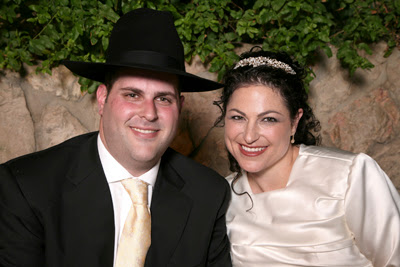
My reason for going to Israel was for my daughter's wedding. Heather had been in school in Israel for the past year and was working for an American company with offices in Jerusalem. Heather met Rob Tzall, an American student studying at a nearby Yeshiva (school), and after a short "courtship" they selected Nov. 4 for their wedding date.


Since my travel groups for the year are usually planned 12 to 18 months in advance, I had to "sandwich" Israel in between France and Cuba. The trip was fabulous in every respect and the wedding was definitely the high point.

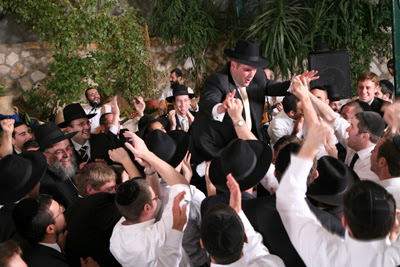
Even though I am Jewish, and have been to many Jewish weddings, this was my first Orthodox Jewish wedding. It was literally the most enjoyable wedding I have ever attended. The rabbis, with their beards, black coats and wide-brimmed hats may look stern and serious, but a wedding is a joyous occasion and they definitely know how to have a good time - and do they love to dance.


Because neither Rob nor Heather comes from an Orthodox background, they were aware we all needed some guidance and set up a class for both families the morning of the wedding. Daniel, a teacher at the local yeshiva, presided over the class and explained the events that would take place before and during the wedding ceremony. A traditional Jewish wedding is full of meaningful rituals, symbolizing the beauty of the relationship of husband and wife, as well as their obligations to each other and to the Jewish people.

The wedding day is considered the happiest and holiest day in the lives of the bride and groom. As on Yom Kippur, the holiest day of the Jewish calendar, the bride and groom fast from dawn until the completion of the marriage ceremony.

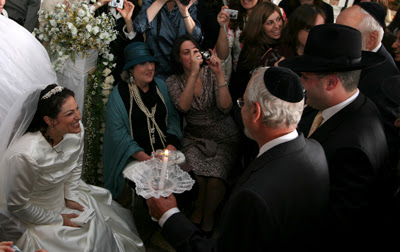
Jewish tradition likens the couple to a queen and king. The bride is seated on a "throne" to receive her guests while the groom, in a separate room, is surrounded by guests who sing and toast him. Up to this time the bride and groom still have not seen one another. In fact, it is also a tradition for the bride and groom not to see each other for the entire week leading up to the wedding, thereby increasing the anticipation and excitement of the event.


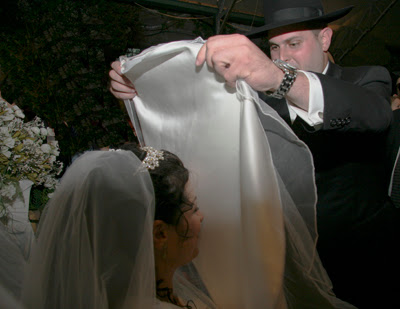
As the ceremony is about to begin, the groom, accompanied by family and friends, enters the room, walks over to his seated bride, and places a veil over her face. The veil symbolizes the idea of modesty and conveys the message that however attractive physical appearances may be, the soul and character of the bride are paramount. It was explained to us in the class that this is an ancient custom and signals the groom's commitment to clothe and protect his wife.


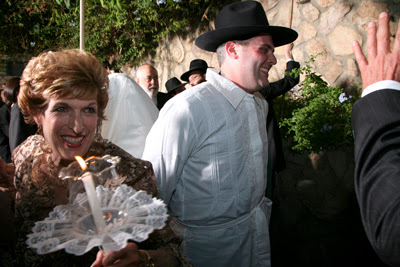
Next, with Rob's mother on one side of Heather, and I on the other, we joined the procession up to the chuppah (canopy), a symbol of the home to be built and shared by the couple.


Once we were all under the chuppah, Heather and I circled Rob seven times. Just as the world was built in seven days, the bride figuratively builds the walls of the couple's new world together. The number seven also symbolizes the wholeness and completeness that they cannot attain separately.


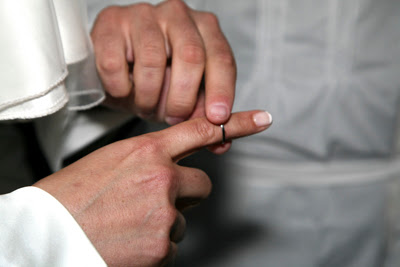
In Jewish law, a marriage becomes official when the groom gives an object of value to the bride. This is traditionally done with a ring. The ring is made of plain gold, "without blemishes or ornamentation." The groom takes the ring in his hand, and in clear view of two witnesses, declares to his wife, "Behold, you are betrothed unto to me with this ring, according to the law of Moses and Israel." According to Jewish law the couple is now considered married, but the ceremony is not over.


Next comes the reading of the ketubah, the marriage contract written in the original Aramaic text. In a Jewish marriage, the groom accepts upon himself various responsibilities, all of which are detailed in the ketubah. His principle obligations are to provide food, shelter and clothing for his wife, and to be attentive to her emotional needs (good luck, Rob!)


The protection of the rights of a Jewish wife is so important that the marriage may not be solemnized until the contract has been completed. The document is signed by two witnesses, and has the standing of a legally binding agreement. The ketubah is the property of the wife and she has access to it throughout their marriage.


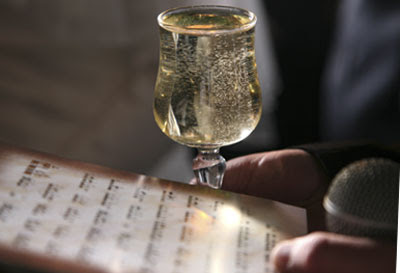
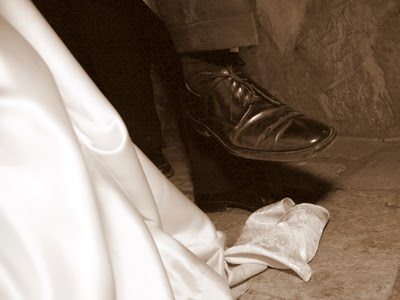
Once the ketubah is signed, the rabbi recites seven blessings. Then a glass is placed on the floor, and the groom shatters it with his foot. This is a common tradition for most Jewish weddings, whether Reform, Conservative or Orthodox, and is an expression of sadness at the destruction of the temple in Jerusalem. According to the rabbi, this act identifies the couple with the spiritual and national destiny of the Jewish people. The breaking of the glass concludes the ceremony and everyone shouts "Mazel Tov!" - good fortune.


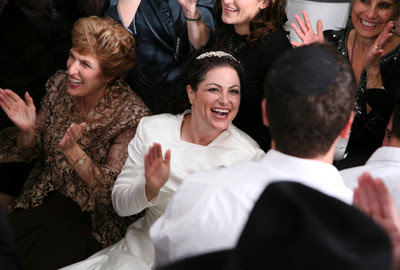
Then the party begins. I realize that most people may think it strange that at an Orthodox wedding men and women celebrate in separate rooms and do not dance together. It may be unusual to us, but it certainly doesn't curtail the festivities. There was a band and everyone danced and danced and danced for hours.


Periodically someone would come over and take Heather (and the family) over to the groom's side for a special performance - acrobatics, juggling, dancing - it was just like in "Fiddler on the Roof." On the women's side there were also special skits and dancing. As a salute to their circus background, Heather and Erin even juggled.


It was truly a wonderful wedding and was definitely the highlight of our trip to Israel. We all have wonderful memories and, with or without a wedding to attend, I highly recommend you consider a trip to Israel in the near future.

Visit Redlands Travel Service for assistance with all your travel needs.